How to use the sheep gestation calculator
- Enter the breeding date. Use the day you saw her mated, the day she got a raddle mark, or the day the ram went in if you don’t know.
- Pick the breed. “Most breeds” uses the classic 147-day average. Pick a breed if you know it, because a Finnsheep and a Merino can be six days apart.
- Read the lambing date. The box shows her due date and the days most ewes lamb in (day 142 to 152).
Under the result, Key dates for this ewe lists how far along she is, the scan window, when to step up feed, the pre-lambing booster and when to start checks. More options lets you work backwards from a lambing date or type your own gestation length if your flock records say your ewes always go a day or two long. You can also add the dates to your phone calendar, print them for the barn wall, or share the link with whoever is doing the night checks.
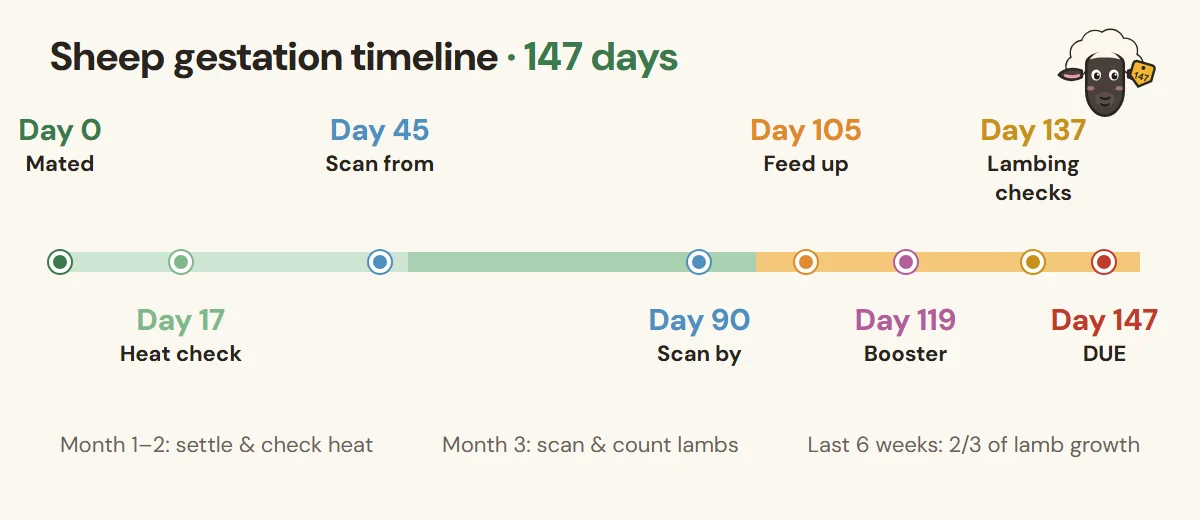
How long are sheep pregnant?
The sheep gestation period is about 147 days, which is just under five months (4.8 months, or 21 weeks). Normal pregnancies run from about 142 to 152 days, so a ewe that lambs five days early or five days late is perfectly normal. That is why this sheep gestation calculator gives you a lambing window, not just one date.
The quick way to do it in your head: add five months and take away about a week. A ewe bred on October 1 lambs around February 25.
How to calculate a sheep’s due date
The math is simple: lambing date = breeding date + 147 days. The calculator does the counting for you, handles months of different lengths and leap years, and swaps in the right number of days for the breed you pick.
Example: a Suffolk ewe marked by the ram on November 10. Suffolks average 145 days, so she is due on April 4. Her window runs from March 30 to April 9. Scan her between Christmas and early February, and start checking her from about March 25.
If you only know when the ram was in, put in the first day he was with the ewes. You’ll get the earliest likely date, and nobody gets caught out by an early lamb.
Sheep gestation length by breed
Breed makes a small but real difference. Prolific, early-maturing breeds such as Finnsheep and Romanov tend to lamb a few days sooner. Fine-wool breeds such as Merino and Rambouillet usually go a few days longer. Most meat and hair breeds sit close to the 147-day average.
| Breed | Type | Average gestation | Normal range | Bred Oct 1 → lambs |
|---|---|---|---|---|
| Most breeds | — | 147 days | 142–152 | Feb 25 |
| Finnsheep | Prolific | 144 days | 139–149 | Feb 22 |
| Romanov | Prolific | 145 days | 140–150 | Feb 23 |
| Suffolk | Meat | 145 days | 140–150 | Feb 23 |
| Hampshire | Meat | 145 days | 140–150 | Feb 23 |
| Dorset | Meat | 145 days | 140–150 | Feb 23 |
| Southdown / Babydoll | Meat | 145 days | 140–150 | Feb 23 |
| Dorper / White Dorper | Hair | 145 days | 140–150 | Feb 23 |
| Katahdin | Hair | 146 days | 141–151 | Feb 24 |
| Texel | Meat | 147 days | 142–152 | Feb 25 |
| Cheviot | Dual | 147 days | 142–152 | Feb 25 |
| Romney | Wool | 148 days | 143–153 | Feb 26 |
| Rambouillet | Fine wool | 149 days | 144–154 | Feb 27 |
| Merino | Fine wool | 150 days | 145–155 | Feb 28 |
Other things that shift the date by a day or two: ewes carrying twins or triplets often lamb a little early; ewes carrying a single big ram lamb often go a little late; and older ewes tend to carry slightly longer than ewe lambs. The calculator can’t see inside her, so treat the window as the real answer.
Sheep pregnancy timeline: what to do and when
The calendar of a ewe’s pregnancy is mostly about three jobs: confirming she is in lamb, feeding her right in the last six weeks, and being ready on lambing day.
| When (from mating) | What happens / what to do |
|---|---|
| Days 14–19 | Return-to-heat check — A ewe that comes back into heat (or gets a fresh raddle mark) about 17 days after mating did not take. Note it and expect her to lamb about 17 days later. |
| Days 45–90 | Pregnancy scan — The easiest window for an ultrasound scan. Scanners can count twins and triplets best in this window, so you can feed ewes by litter size. |
| Day 105 | Step up the feed — About two thirds of a lamb's growth happens in the last six weeks. Raise energy slowly, more for ewes carrying twins or triplets, to avoid pregnancy toxemia. |
| Day 119 | Booster, crutch or shear — Many flocks give the ewe a clostridial (CD&T) booster and crutch or shear her 2–4 weeks before lambing. Ask your vet which vaccine plan fits your flock. |
| Day 137 | Start lambing checks — Set up jugs and the lambing kit. Check the ewe at least morning and evening, and more often once she shows signs. |
| Days 142–152 | Lambing window — Most ewes lamb within five days either side of the due date. |
| Day 147 | Due date — The average lambing day for this gestation length. |
How to tell if a ewe is pregnant
- No return to heat. Ewes cycle about every 17 days. If a ewe is not re-marked by the ram (or doesn’t show heat) 14–19 days after mating, she has probably settled.
- Ultrasound scan. The most reliable on-farm check. Between day 45 and 90 a scanner can confirm pregnancy and count lambs.
- Blood test. A pregnancy blood test (PAG test) works from about 30 days after mating and is handy for small flocks without a scanner nearby.
- Late signs. In the last month the belly drops and the udder starts to fill. By then you will usually know anyway.
Signs a ewe is about to lamb
From about 10 days before her date, check her morning and evening. Signs that lambing is close:
- The udder fills and the teats look tight and shiny, often in the last day or two.
- The vulva swells and goes loose and pink.
- She sinks in front of the hips, as the lambs drop into position.
- She goes off on her own, stops eating, paws the ground, lies down and gets up again, or looks at her sides.
- The water bag appears. A ewe should have her first lamb within about an hour after that. If she strains for more than 30–60 minutes with no progress, check her or call your vet.
Write each ewe’s lambing window on a whiteboard in the barn. When three ewes are due the same week, you’ll know who to watch first.
Sheep gestation questions
How many months is a sheep pregnant?
About five months. The average gestation period of a sheep, 147 days, is 4.8 months, or 21 weeks. The normal range is 142 to 152 days.
Can a ewe lamb early?
Yes. Lambs born from about day 142 on are normal and usually strong. Lambs born before about day 138 are premature and may need help to breathe, suck and stay warm.
How many lambs does a ewe have?
Usually one or two. Twins are common in most commercial flocks, and prolific breeds like Finnsheep and Romanov often have triplets or more. A scan in the day 45–90 window tells you what to expect.
When should I breed sheep for spring lambs?
Count back about five months. For lambs in early April, put the ram in around early November. The lambing calculator does this for you with the “plan backwards” option.
How soon after lambing can a ewe be bred again?
Most ewes are bred once a year in the fall. Some breeds (Dorset, Dorper, Katahdin and others) can breed out of season, and accelerated systems lamb three times in two years, usually rebreeding about two months after lambing.
Is sheep gestation the same as goat gestation?
Close, but not the same. Goats average about 150 days, a few days longer than sheep. A goat gestation calculator is coming soon on this site.