How to read the goat gestation chart
Say a doe was bred on November 10. Go to the Nov column, then down to row 10: at 150 days the cell reads Apr 9. That is her due date. She can kid any time from about five days before to five days after, so from April 4 to April 14.
Pick the right year before you print. A leap day in February shifts every kidding date after it by one day, and the chart takes care of that for the year you choose. For a single doe it’s quicker to use the goat gestation calculator, which also lists the dates for the pregnancy test, drying off, the CD&T booster and kidding checks.
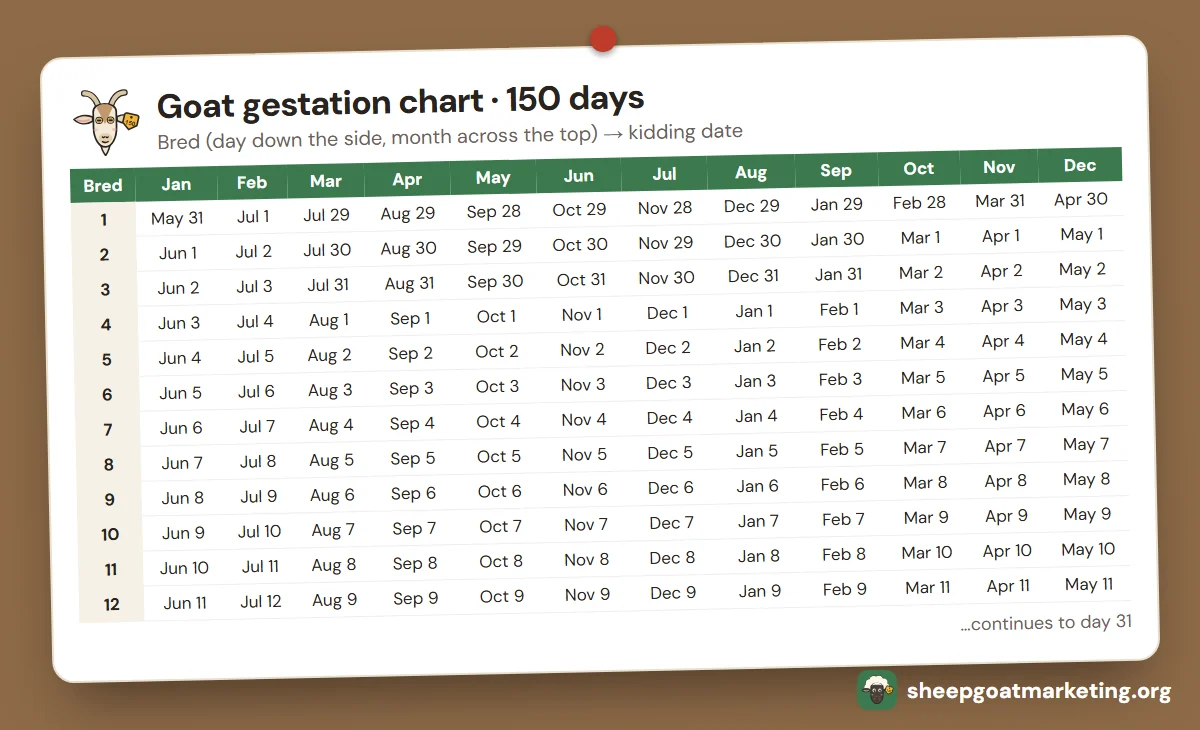
Breeding a whole herd? Circle the day the buck goes in and the day he comes out. The cells between those two days hold every kidding date you can expect that season.
Goat gestation table, by month
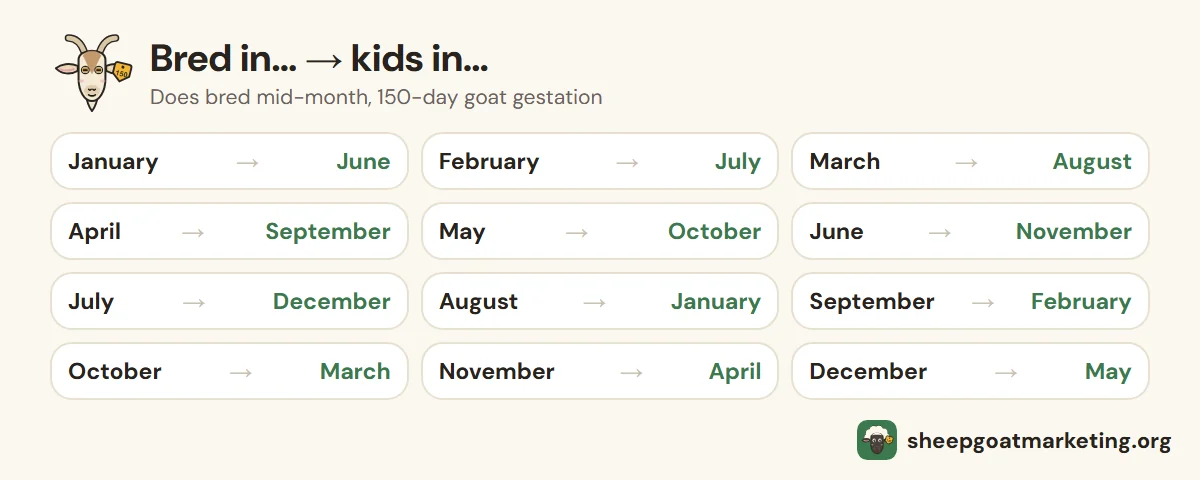
If you only need the rough picture, this shorter goat gestation table shows the kidding date for does bred on the 1st and the 15th of each month at 150 days. Bred in autumn, kids in late winter or spring; bred in late winter, kids in summer.
| Buck in… | Bred on the 1st → kids | Bred on the 15th → kids | Kidding month |
|---|---|---|---|
| January | May 31 | Jun 14 | June |
| February | Jul 1 | Jul 15 | July |
| March | Jul 29 | Aug 12 | August |
| April | Aug 29 | Sep 12 | September |
| May | Sep 28 | Oct 12 | October |
| June | Oct 29 | Nov 12 | November |
| July | Nov 28 | Dec 12 | December |
| August | Dec 29 | Jan 12 | January |
| September | Jan 29 | Feb 12 | February |
| October | Feb 28 | Mar 14 | March |
| November | Mar 31 | Apr 14 | April |
| December | Apr 30 | May 14 | May |
Which number of days should I use?
150 days is the figure most goat keepers and extension guides use, and it fits the big dairy breeds (Nubian, Alpine, Saanen, LaMancha, Toggenburg, Oberhasli) and the meat breeds (Boer, Kiko, Spanish). Nigerian Dwarf and Pygmy does usually kid a few days sooner, so pick the breed in the box above and the chart switches to their length. Best of all, if you have a few years of kidding records, type your own average into More options.
| Breed | Type | Average gestation | Normal range | Bred Oct 1 → kids |
|---|---|---|---|---|
| Most breeds | — | 150 days | 145–155 | Feb 28 |
| Nigerian Dwarf | Miniature dairy | 147 days | 142–152 | Feb 25 |
| Pygmy | Miniature | 147 days | 142–152 | Feb 25 |
| Boer | Meat | 149 days | 144–154 | Feb 27 |
| Angora | Fibre | 149 days | 144–154 | Feb 27 |
| Kiko | Meat | 150 days | 145–155 | Feb 28 |
| Spanish / Savanna | Meat | 150 days | 145–155 | Feb 28 |
| Nubian / Anglo-Nubian | Dairy | 150 days | 145–155 | Feb 28 |
| Alpine / British Alpine | Dairy | 150 days | 145–155 | Feb 28 |
| Saanen | Dairy | 150 days | 145–155 | Feb 28 |
| LaMancha | Dairy | 150 days | 145–155 | Feb 28 |
| Toggenburg | Dairy | 150 days | 145–155 | Feb 28 |
| Oberhasli | Dairy | 150 days | 145–155 | Feb 28 |
Whatever number you use, treat each cell as the middle of a window, not a promise. Does with triplets often kid a little early. A doe carrying a single big buckling may go a little late.
Planning a kidding season with the chart
The chart is most useful before breeding, when you decide when the buck goes in. Work backwards from the month you want kids. For kids from about March 1, the buck goes in around October 2. For April kids, early November. For kids born on pasture in May, early December.
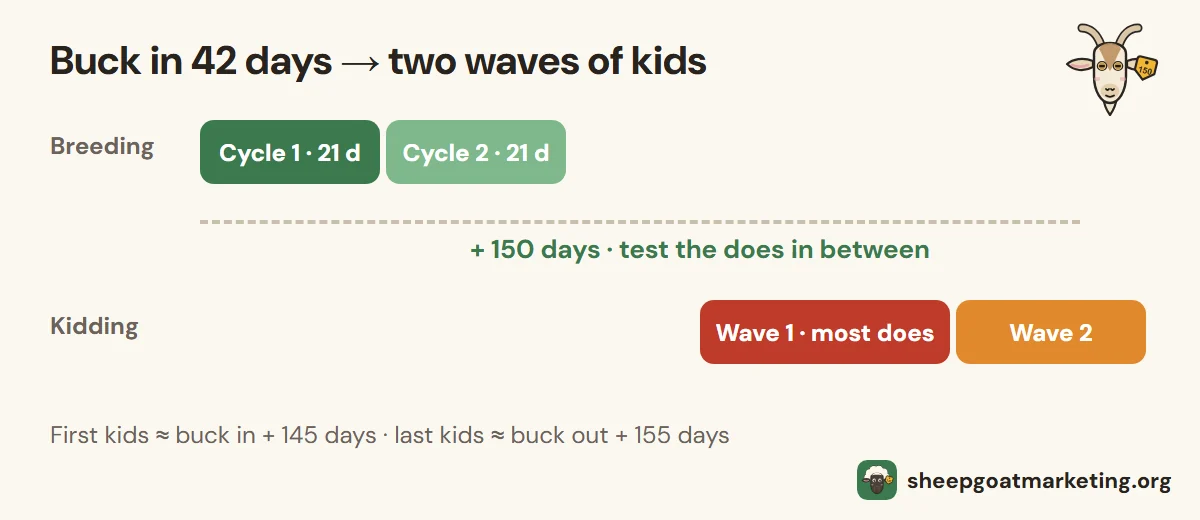
Does cycle about every 21 days, so a buck left in for 42 days gets two chances at every doe. The first kids arrive about 145 days after the buck goes in. The last arrive about 155 days after he comes out. With a buck in from October 1 to November 11, that is roughly February 23 to April 15. Mark both dates on the chart and you can see your whole kidding season at a glance.
A few practical points when picking the season:
- Weather and housing. Kids born in the coldest weeks need a dry barn with no draughts. If you kid outside, aim for spring.
- Milk. Dairy herds often spread breeding so that some does freshen in spring and some later, to keep milk coming all year.
- Shows and sales. Many shows and kid sales set age classes by birth date, so plan back from the date that matters to you.
- Your own time. Kidding means night checks for a few weeks. Pick weeks when you or a helper can be home.
Printing the goat gestation chart
Use the Print this chart button. The page prints only the chart, without the menus, and landscape fits it best. Print one sheet per breeding year. A clear plastic sleeve keeps it clean in the barn, and a dry-wipe marker lets you write doe names on it and wipe them off next year. If you change the breed or type your own number of days first, the printout uses that number.
Goat gestation chart questions
What is a 150-day goat gestation chart?
It is a lookup chart that adds 150 days, the average goat pregnancy, to every day of the year. Instead of counting days on a calendar for each doe, you find the breeding date and read the kidding date.
Is there a 145-day chart for Nigerian Dwarf goats?
Yes. Pick Nigerian Dwarf or Pygmy in the breed box (147 days), or type 145 into More options. The whole chart switches and you can print it.
Can I print the goat gestation chart?
Yes. Use the print button: only the chart prints, without menus. Landscape fits best.
Should I use the chart or the calculator?
Use the chart to plan a breeding season or to look up many does at once. Use the calculator for one doe: it gives her window and every key date in her pregnancy, and can add them to your calendar.
How accurate is a goat gestation chart?
As accurate as the breeding date you start from. Most does kid within five days of the date in the chart. If you only know the week the buck was in, read the whole week across the chart to get the range.