How to use the goat gestation calculator
- Enter the breeding date. Use the day you saw the buck cover her, the day of a hand-breeding, or the day the buck went in with the does if you don’t know the exact day.
- Pick the breed. “Most breeds” uses the standard 150-day goat gestation. Miniature breeds such as Nigerian Dwarf and Pygmy usually kid a few days sooner, so pick the breed if you know it.
- Read the kidding date. The box shows her due date and the days most does kid in (day 145 to 155).
Under the result, Key dates for this doe lists how far along she is today, when to watch for a return to heat, when a pregnancy test works, when to dry off a milking doe, when to raise her feed, the CD&T booster and when to start kidding checks. More options lets you work backwards from a kidding date to the breeding date, or type your own gestation length if your herd records say your does always go a day or two long. You can add every date to your phone calendar, print them for the barn, or share the link with whoever does the late checks.
How long are goats pregnant?
The goat gestation period is about 150 days. That is almost exactly five months: 4.9 months, or a little over 21 weeks. Normal pregnancies run from about 145 to 155 days, so a doe that kids five days before or after her date is right on time. That is why the goat gestation calculator gives a kidding window, not just one day.
The quick way to do it in your head is five months, minus a day or two. A doe bred on October 1 is due around February 28. A doe bred on November 2 is due around April 1.
Small breeds run a little shorter. Nigerian Dwarf and Pygmy does often kid around day 145 to 147, while the big dairy breeds (Nubian, Alpine, Saanen, LaMancha, Toggenburg, Oberhasli) and the meat breeds (Boer, Kiko, Spanish) sit close to 150 days.
How to calculate a goat’s due date
The sum is simple: kidding date = breeding date + 150 days. The calculator does the counting for you, handles months of different lengths and leap years, and swaps in the right number of days for the breed you pick.
Example: a Nigerian Dwarf doe is bred on November 10. At 147 days she is due on April 6, and her window runs from April 1 to April 11. A pregnancy blood test works from about December 10. If she is in milk, dry her off around February 5. Give her CD&T booster around March 7, and start checking her ligaments from about March 27.
Counting by hand is where most mistakes happen: it is easy to slip a day at the end of a month or to forget February. Work out the date once here and write it on the barn calendar.
Goat gestation length by breed
Breed changes the date by a few days at most. Miniature and dwarf breeds kid a little sooner. The large dairy and meat breeds average about 150 days. The table shows the typical length for each breed and the normal range around it.
| Breed | Type | Average gestation | Normal range | Bred Oct 1 → kids |
|---|---|---|---|---|
| Most breeds | — | 150 days | 145–155 | Feb 28 |
| Nigerian Dwarf | Miniature dairy | 147 days | 142–152 | Feb 25 |
| Pygmy | Miniature | 147 days | 142–152 | Feb 25 |
| Boer | Meat | 149 days | 144–154 | Feb 27 |
| Angora | Fibre | 149 days | 144–154 | Feb 27 |
| Kiko | Meat | 150 days | 145–155 | Feb 28 |
| Spanish / Savanna | Meat | 150 days | 145–155 | Feb 28 |
| Nubian / Anglo-Nubian | Dairy | 150 days | 145–155 | Feb 28 |
| Alpine / British Alpine | Dairy | 150 days | 145–155 | Feb 28 |
| Saanen | Dairy | 150 days | 145–155 | Feb 28 |
| LaMancha | Dairy | 150 days | 145–155 | Feb 28 |
| Toggenburg | Dairy | 150 days | 145–155 | Feb 28 |
| Oberhasli | Dairy | 150 days | 145–155 | Feb 28 |
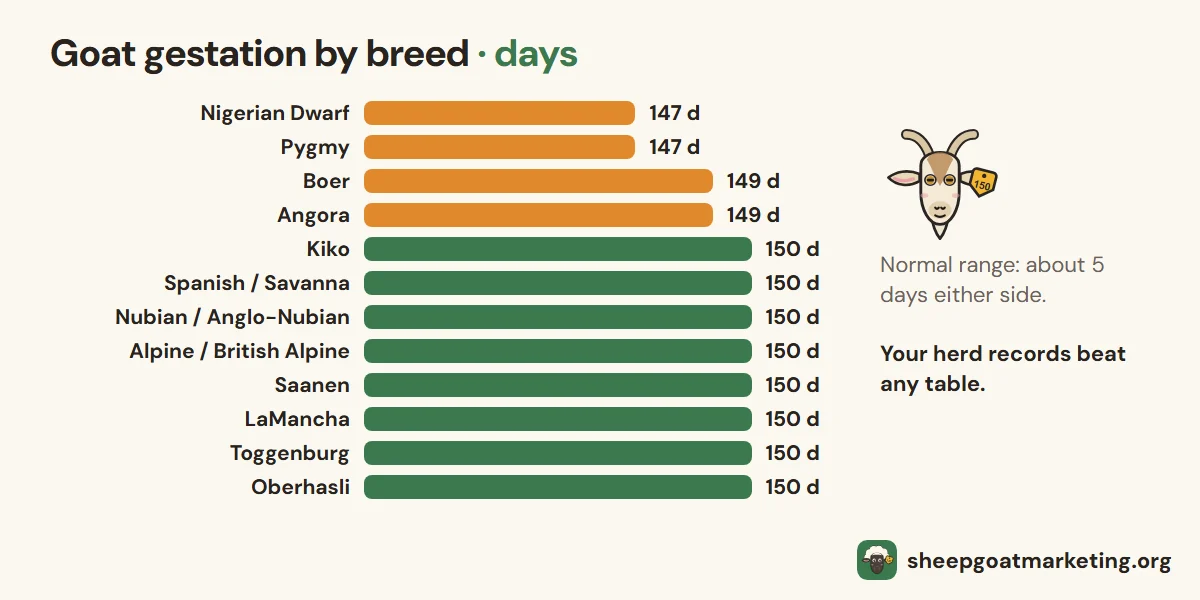
A few other things move the date by a day or two. Does carrying triplets or quads often kid a little early. Does carrying a single big buckling often go a little late. First fresheners can be less predictable than older does. If your herd keeps records, your own average beats any table: type it into More options and every date updates.
Goat pregnancy timeline: what to do and when
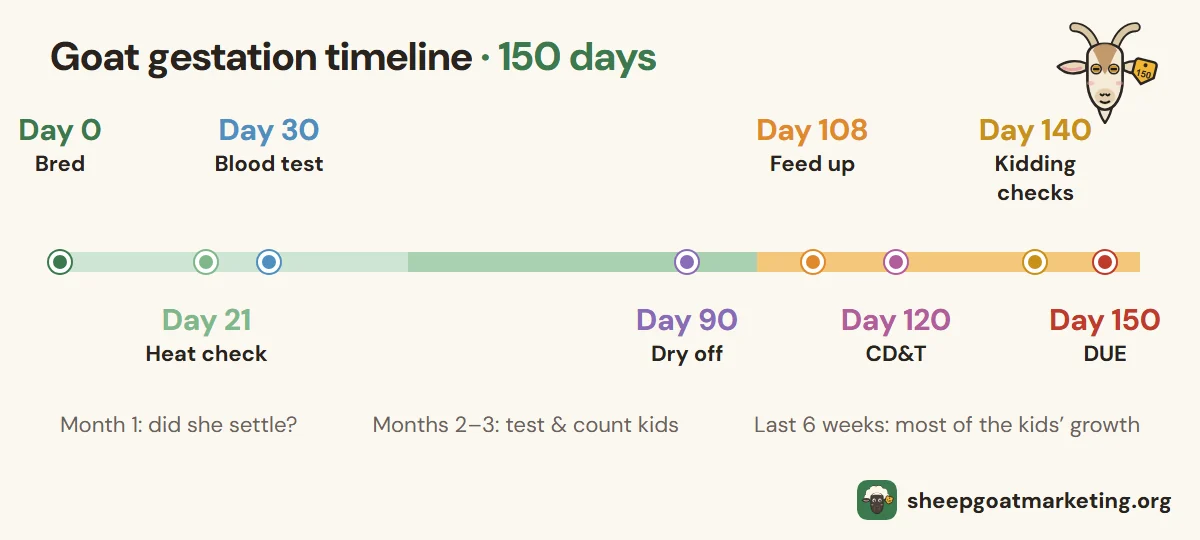
A doe’s pregnancy comes down to four jobs: confirm that she settled, dry her off if she is milking, feed her well in the last six weeks, and be ready on kidding day. The dates below are counted from the day she was bred.
| When (from mating) | What happens / what to do |
|---|---|
| Days 18–24 | Return-to-heat check — Does cycle about every 21 days. A doe that comes back into heat 18–24 days after breeding did not settle. Note the new date: she will kid about three weeks later than planned. |
| Days 30–90 | Pregnancy check — A pregnancy blood test works from about day 30. An ultrasound scan confirms it from about day 40, and between day 45 and 90 the scanner can usually count the kids. |
| Day 90 | Dry off milking does — Stop milking a dairy doe about two months before she kids, so her udder can rest and build up colostrum for the kids. |
| Day 108 | Step up the feed — Most of a kid's growth happens in the last six weeks. Raise energy slowly, more for does carrying twins or triplets, to avoid pregnancy toxemia. |
| Day 120 | CD&T booster — Many herds give the doe a CD&T booster about a month before kidding, so the kids get antibodies in the colostrum. Ask your vet which vaccine plan fits your herd. |
| Day 140 | Start kidding checks — Set up a clean kidding pen and the kidding kit. Check the doe morning and evening, and more often once her ligaments soften. |
| Days 145–155 | Kidding window — Most does kid within five days either side of the due date. |
| Day 150 | Due date — The average kidding day for this gestation length. |
How to tell if a doe is pregnant
- No return to heat. Does cycle about every 21 days. If she shows no heat (no tail flagging, bleating or interest in the buck) 18 to 24 days after breeding, she has probably settled.
- Blood test. A pregnancy blood test, sent to a lab, works from about 30 days after breeding. It is cheap and reliable, and handy for small herds.
- Ultrasound. A vet or scanner can confirm the pregnancy from about day 40. Between day 45 and 90 they can usually count the kids too, so you know who needs extra feed.
- Late signs. In the last month or two her belly widens and her udder starts to fill. In first fresheners the udder may only fill in the last few weeks, so don’t rely on it alone.
Signs a doe is about to kid
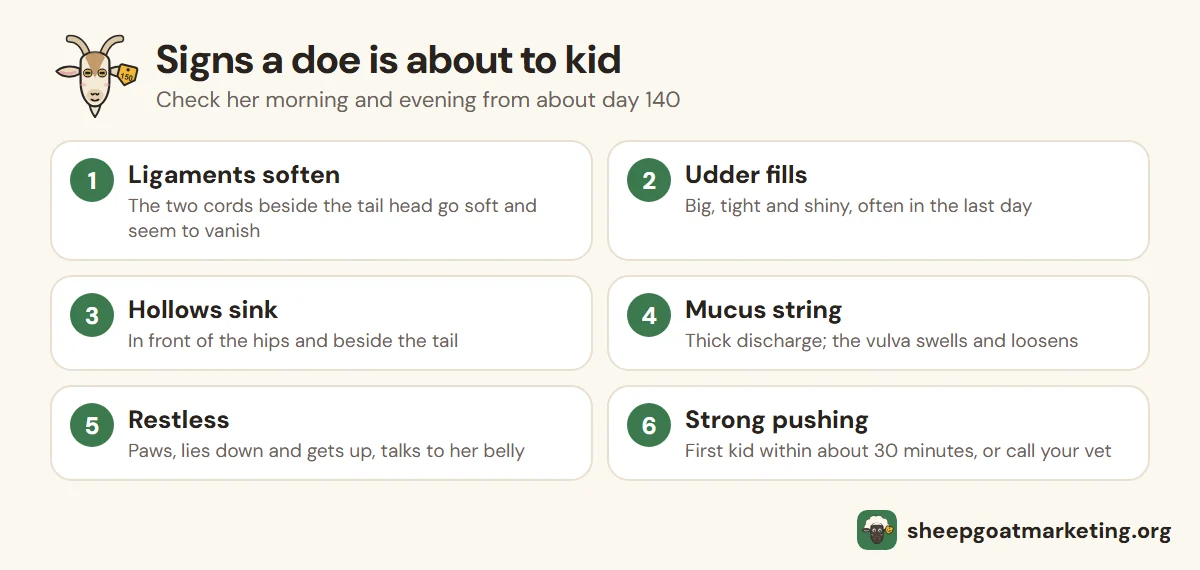
From about ten days before her date, check her morning and evening. These signs mean kidding is getting close:
- The ligaments soften. The two firm ligaments on either side of the tail head go soft and then seem to disappear. Many does kid within about 12 to 24 hours of that.
- The udder fills. It gets big, tight and shiny, often in the last day.
- The hollows sink. The area in front of her hips and beside the tail sinks as the kids move into position.
- Discharge. A string of thick mucus hangs from the vulva, which also swells and goes loose.
- Her behaviour changes. She goes off on her own, paws at her bedding, lies down and gets up, stretches, talks to her belly or stops eating.
- Strong pushing. Once the water bag shows and she starts pushing hard, the first kid usually arrives within about 30 minutes. If she pushes hard for 30 minutes with no progress, check her or call your vet.
From day 140, feel the ligaments either side of her tail head every evening. On the night you can’t find them any more, stay close to the barn.
Planning when to breed your does
Most goat breeds are seasonal: they come into heat as the days get shorter, which in the northern hemisphere is roughly late summer to winter. Nigerian Dwarf and Pygmy goats, and many Boers, can be bred almost any time of year. To pick a breeding date, count back 150 days from when you want kids. For kids from March 1, breed around October 2. For kids in April, breed in early November.
If the buck runs with the does, leave him in for two heat cycles (about 42 days) and the kids will arrive over about seven weeks. The goat gestation chart shows the kidding date for every breeding day of the year in one printable table, which makes planning a whole herd quicker.
Goat gestation questions
How many months is a goat pregnant?
About five months. The average goat gestation, 150 days, is 4.9 months or just over 21 weeks. The normal range is 145 to 155 days.
Can a goat kid early?
Yes. Kids born from about day 145 on are normal and usually strong, and does with triplets often kid a few days early. Kids born more than about a week early are premature. They may need help to breathe, stand, suck and stay warm, so call your vet.
How many kids does a goat have?
Usually one to three. First fresheners often have one or two. Twins are the most common in most herds, and Nigerian Dwarf and Boer does often have triplets or more. An ultrasound between day 45 and 90 tells you what to expect.
How long is a Nigerian Dwarf goat pregnant?
About 145 to 150 days, a few days less than the big dairy breeds. Pick Nigerian Dwarf in the breed box and the calculator uses 147 days.
When can a doeling be bred?
Most breeders wait until a doeling has reached about two thirds of her adult weight. For many breeds that is around 7 to 10 months old. Breeding too young can stunt her growth, so ask your vet or an experienced breeder about your breed.
Is goat gestation the same as sheep gestation?
Close, but goats run a few days longer: about 150 days against 147 for sheep. For ewes, use the sheep gestation calculator.